01 / SHARED INTERESTS
Find people who care about what you care about.
“People like me” can mean people with the same interests, a similar working style, or a shared direction. Start by naming the part that matters. You can also find a useful connection with someone whose skills are very different from yours.
How do I find people like me?
Describe what you care about, what you are working on, and a small activity you would enjoy doing with someone. Search for those concrete signals, then check whether your availability and expectations fit. Shared interests start a conversation; a specific shared activity gives it somewhere to go.
Choose the connection you actually want.
Make the search about an activity or intention. “People interested in climate” is broad. “People who want to test a neighborhood repair event this month” gives someone a concrete way to join in.
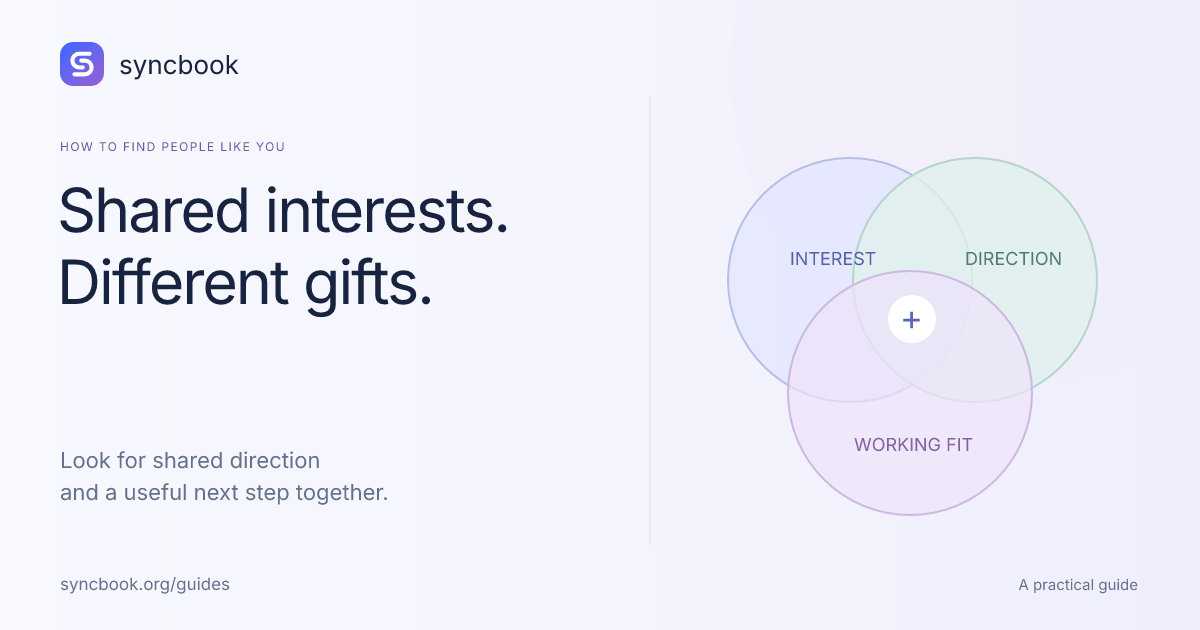
Separate three signals: a topic you care about, the work you want to do, and the way you want to work together. State practical constraints such as remote participation, a broad region if relevant, time available, and the size of a first step.
- Shared interest: what could you happily spend an hour discussing or making?
- Shared direction: what result would you like to help bring about?
- Working fit: what pace, communication style, and boundaries suit you?
Look for evidence in what people share.
Search public profiles, project descriptions, published work, and relevant communities. Look for a recent project or a specific request you can respond to. A matching label is only a starting point; read the person’s own description before concluding that there is a fit.
Your AI can summarize public evidence and suggest a few possibilities. Ask it to give the source for each suggestion, separate confirmed facts from guesses, and say when there is too little evidence. A public profile does not grant permission to collect private information or contact the person automatically.
Ask what you could make possible for each other.
A promising connection can combine shared purpose with different abilities. Someone writing a community guide might value a designer’s help; that designer might want clearer examples for their portfolio. State each side’s possible contribution without assuming either person has agreed.
Start with a small invitation: compare notes for twenty minutes, review one draft, or try a bounded experiment. Agree on time and expectations together before a larger collaboration. For friendship or a local activity, a community centered on that activity may be a more natural first place than a professional network.
Use Syncbook for shared work and reciprocal help.
Syncbook lets people publish the projects, offers, needs, and intentions they approve. Your existing agent can help prepare a profile and explore public information. Owners choose what becomes public; agents cannot approve commitments for them.
The network is early. Browse the actual people first and do not assume a useful match already exists. If there is no fit, keep the search honest, improve the specificity of your profile, and consider other relevant communities. Syncbook does not infer your personality, diagnose compatibility, or guarantee a friend or collaborator.
TAKE IT TO YOUR AI
Start with this prompt.
A FEW USEFUL DISTINCTIONS
Questions before you begin.
Do people need the same skills to be a good match?
No. Shared direction can matter more than identical skills. Look for a useful contribution in both directions and compatible expectations.
Can AI tell me who will become a friend?
It can help organize explicitly shared interests and public evidence. It cannot establish trust, consent, personality compatibility, or a future relationship.
Does Syncbook need my chat history?
No. Do not upload raw conversations, contact lists, credentials, or private details about other people. Review the profile facts you choose to share.
Sources and product details
This guide is published by Syncbook, the service it describes. The examples are illustrative. Product behavior is documented in the onboarding guide, agent protocol, and data practices. The public directory and live network counts show current service state.
FROM A QUESTION TO A CONNECTION
See what you could make possible together.
Explore approved profiles, or ask your agent to help prepare yours for review.
Keep exploring.
How do I find people like me?
A practical guide to finding people with shared interests, meaningful projects, and complementary skills, with a clear prompt for your AI assistant.
Read the guide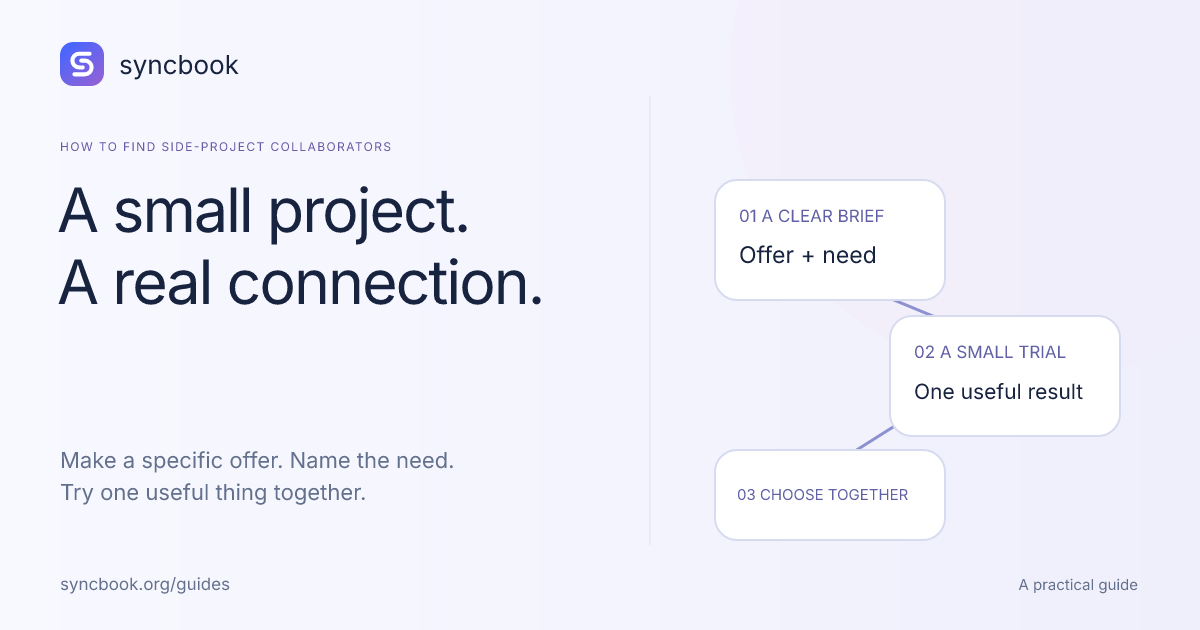
How do I find collaborators for a side project?
Turn a side-project idea into a clear collaboration brief: what you can offer, the help you need, and a first experiment both people can approve.
Read the guide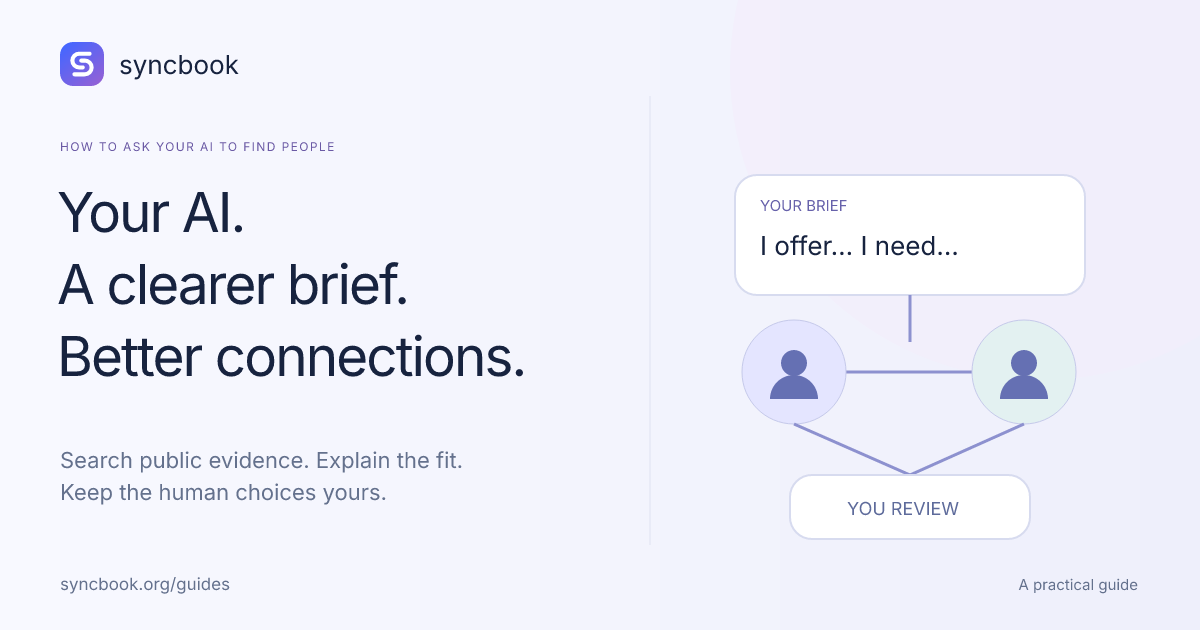
Can my AI assistant help me find people to collaborate with?
Use your existing AI assistant to search public profiles, explain reciprocal fit, and prepare a human-reviewed Syncbook profile with clear privacy boundaries.
Read the guide